
The Problem
You're eating more food than your grandparents to get the same nutrition.
The mineral gap
Grown bigger. Filled with less.
Line up the USDA's own nutrient tables from 1950 against the ones from 2000, and the very same fruits and vegetables come up short. Across 43 common garden crops, average calcium fell about 16%, iron and vitamin C about 15% each, and riboflavin nearly 40%.1,2
The fruit looks the same. It tastes mostly the same. It isn't the same — the same crop simply carries less of what your body needs than it did two generations ago.
None of that is permanent, though. Grow the same crop in living, biology-rebuilt soil instead of tired ground, and the minerals climb back. The gap between conventional produce and food from restored soil — measured today — is wider than most people expect:

Same produce. Different soil.
Representative nutrient density of common produce — conventional store-bought vs. regeneratively grown from biology-rebuilt soil. All values normalized to the conventional baseline.
- Calcium×2.2
- Magnesium×3.4
- Iron×2.8
- Zinc×2.5
- Vitamin C×1.9
- Vitamin A×2.4
It's not just the plants
The animal eats what the soil grew. You eat what the animal ate.
A grass-finished steer raised on a diverse, well-managed pasture isn't producing the same beef as a feedlot steer finished on corn and soy. Same animal, same cut, different food.
The nutrients that matter most in red meat — the omega-3 fatty acids, the conjugated linoleic acid (CLA), the fat-soluble vitamins A and E — track almost directly with what the animal ate in its last 90–120 days of life. Grain-finished beef is heavier on the omega-6 side. Pasture-finished beef from biology-rebuilt land is heavier on the omega-3 side, with substantially more CLA.3
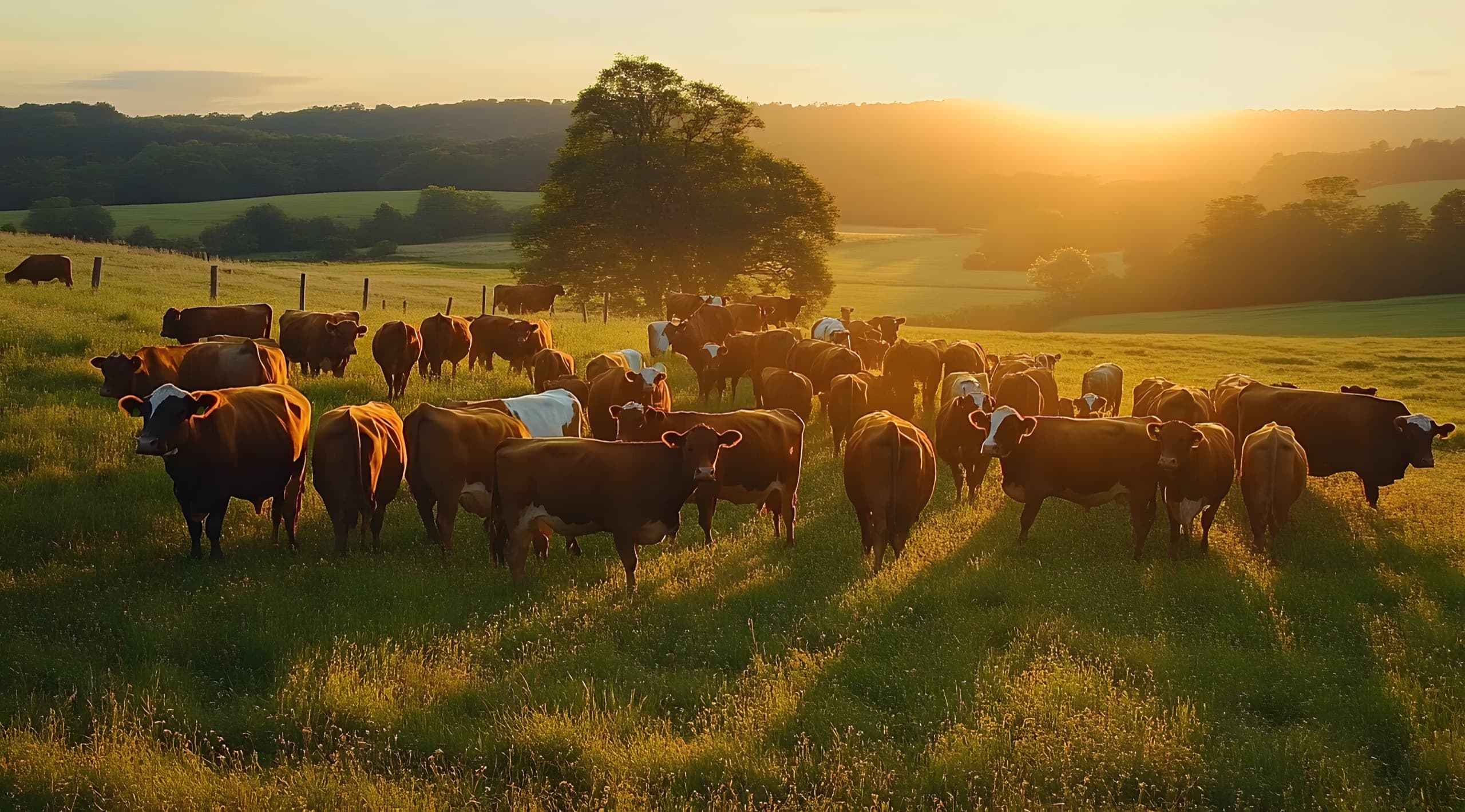
Same beef. Different pasture.
Representative nutrient density — grain-fed beef vs. pasture-raised, grass-finished beef from regeneratively-managed land. All values normalized to the grain-fed baseline.
- Omega-3 fatty acids×4.0
- CLA (conjugated linoleic acid)×2.5
- Vitamin E×2.7
- Beta-carotene×7.0
- Vitamin A (retinol)×2.3
This is why “grass-fed” alone isn't quite the right standard. Almost all beef cattle in America eat grass at some point in their lives — most are then finished on grain in the last 90–120 days, which is exactly when the nutrient profile of the final meat is determined. The standard that maps to nutrient density is grass-fed and grass-finished, on land that's actually being regenerated rather than overgrazed.
The organic myth
Organic controls what's sprayed on your food — not what's in it.
Going organic is a real step, and worth taking. What you're buying is the absence of synthetic chemicals, and that matters. The clearest evidence is about the people closest to them: decades of studies following farmers and farmworkers tie heavy, long-term pesticide exposure to serious illness — most strongly Parkinson's disease, solidly enough that European regulators reviewed it themselves and found a biologically plausible path from exposure to nerve damage.4,5
That evidence is about handling these chemicals in bulk, season after season — not the traces on grocery-store produce. But “no proof of harm at low doses” isn't the same as “proven safe,” and when the people most exposed are getting measurably sick, choosing food grown without them is a reasonable, cautious call — especially for a pregnant mother or a growing child.
So why isn't organic the finish line? Because the label regulates what isn't sprayed on your food — not what is in it. There's no minimum mineral standard to earn the seal. An organic carrot grown in tired, biologically dead soil is still a low-mineral carrot; it just doesn't carry the residue.
Organic answers the chemical question and leaves the nutrient question wide open. Regenerative growing answers both: rebuild the soil's biology and you get food that's clean and dense.
Why this happened
The minerals never left the soil. They stopped reaching your plate.
Two things happened between the ground and your plate. Crops were bred to grow bigger and faster, spreading the same minerals thinner through every bite1,2 — and the living part of the soil that carries those minerals into the plant was taken apart.
Healthy dirt is a vast underground network of fungi and microbes that works like an extension of every plant's roots. The most important — mycorrhizal fungi — thread into the roots and reach far into the soil, pulling in hard-to-get minerals like zinc and phosphorus and delivering them straight to the plant. Roughly 80% of food crops depend on this partnership.6,7
Industrial farming quietly dismantles it. Heavy tillage rips the fungal networks apart every season. Synthetic fertilizer tells the plant it no longer needs the partnership, so it stops feeding the fungi and they fade. Broad-spectrum fungicides kill beneficial soil fungi alongside their targets. The minerals may still be in the ground, but the biology that moves them from soil into food has been broken.
Bigger plants diluting their nutrients, broken fungal networks, soil life suppressed by chemicals and tillage — stack it together and you get the food on today's shelves. It looks the same as it always did; it just carries less of what your body needs. The good news: none of it is permanent. Soil biology can be rebuilt.
The blueprint
The fix isn't new. It's old, restored.
Five practices. They scale from a windowsill to a ranch.
No-till
Stop turning the soil over. Every till destroys the fungal network it took a season to build.
Cover crops
Living roots in the ground year-round. Bare soil is a wound; cover it.
Plant diversity
Polyculture, not monoculture. Different roots reach different depths and feed different microbes.
Animal integration
Chickens, worms, beneficial insects — even at backyard scale. Their byproducts close the nutrient loop.
Compost + biology
Feed the soil what it actually wants: a diversity of microbial life, not nitrogen alone.
Here's what we built
Good Soil Society is the practical bridge.
The framework above is what we wish someone had handed us five years ago — so we're building it into your pocket. Sower is one regenerative AI with multiple modes, grounded in the writers, ranchers, and researchers we've learned from. Conversational Mode opens first: ask anything in plain English and get the regenerative answer, with its sources. Garden Planner — a zone-tuned, season-by-season plan — is still in development, with more modes behind it.
Sources
Peer-reviewed references for the factual claims on this page, in the order they appear.
- Davis, D. R., Epp, M. D., & Riordan, H. D. (2004). “Changes in USDA Food Composition Data for 43 Garden Crops, 1950 to 1999.” Journal of the American College of Nutrition, 23(6), 669–682. doi:10.1080/07315724.2004.10719409
- Marles, R. J. (2017). “Mineral nutrient composition of vegetables, fruits and grains: the context of reports of apparent historical declines.” Journal of Food Composition and Analysis, 56, 93–103. doi:10.1016/j.jfca.2016.11.012
- Daley, C. A., Abbott, A., Doyle, P. S., Nader, G. A., & Larson, S. (2010). “A review of fatty acid profiles and antioxidant content in grass-fed and grain-fed beef.” Nutrition Journal, 9, 10. doi:10.1186/1475-2891-9-10
- Pouchieu, C., et al. (2018). “Pesticide use in agriculture and Parkinson’s disease in the AGRICAN cohort study.” International Journal of Epidemiology, 47(1), 299–310. doi:10.1093/ije/dyx225
- EFSA PPR Panel. (2017). “Investigation into experimental toxicological properties of plant protection products having a potential link to Parkinson’s disease and childhood leukaemia.” EFSA Journal, 15(3), 4691. doi:10.2903/j.efsa.2017.4691
- Smith, S. E., & Smith, F. A. (2011). “Roles of arbuscular mycorrhizas in plant nutrition and growth: new paradigms from cellular to ecosystem scales.” Annual Review of Plant Biology, 62, 227–250. doi:10.1146/annurev-arplant-042110-103846
- Nguyen, T. D., Cavagnaro, T. R., & Watts-Williams, S. J. (2019). “The effects of soil phosphorus and zinc availability on plant responses to mycorrhizal fungi: a physiological and molecular assessment.” Scientific Reports, 9, 14842. doi:10.1038/s41598-019-51369-5
Where to start
You've read the why. Here's the how.
Join free and put Sower in your pocket, or skip straight to the food — the directory lists producers who've committed to the Good Soil Standard, with what they sell and where to find them.